Inclusion bundle for Secondary Years
White paper bundle for Secondary Years
The Government’s Schools White Paper aims to put inclusion first. It outlines plans to reform the support children and young people with special educational needs and disabilities (SEND) get at school so that every child or young person can have the best start in life. This includes things like a £1.6 billion fund to boost inclusion in mainstream settings, new individual support plans, and more.
There’s a lot of information to get to grips with. That’s why we’ve put together our inclusion learning bundles. These collections of resources are designed to help you feel ready for the upcoming changes. They focus on speech, language, and communication skills. These are the building blocks of learning, emotional wellbeing and social development throughout education.
There are free and paid-for resources available, tailored to educators like you. They include tools and strategies you can use straight away. You’ll learn about how you can support all children and young people’s speech and language development at the universal level, adapt support for those at targeted and targeted plus levels, and more.
The Government’s Schools White Paper aims to put inclusion first. It outlines plans to reform the support young people with special educational needs and disabilities (SEND) get at school so that every young person can learn and thrive. This includes things like a £1.6 billion fund to boost inclusion in mainstream settings, new individual support plans to help young people, and more.
There’s a lot of information to get to grips with. That’s why we’ve put together our white paper learning bundles. These collections of resources are designed to help you feel ready for the upcoming changes. They focus on speech, language, and communication skills. These skills underpin all academic learning, social and emotional wellbeing, and successful preparation for adulthood throughout the secondary years.
There are free and paid-for resources available, tailored to secondary educators like you. They include tools and strategies you can use straight away. You’ll learn about how you can support all young people’s speech and language development at the universal level, adapt support for young people at targeted and targeted plus levels, and more.
Free resources
Communication standards audit - secondary
A communication standards audit to help secondary settings develop a setting-wide approach to supporting communication skills
Free resources
Setting audit tool - secondary

Coming soon!
Paid-for resources
Typical speech and language development at secondary school
Coming soon!
Developmental language disorder (DLD) – a hidden challenge
Coming soon!
Developmental language disorder (DLD): Ways to support young people
Coming soon!
Paid-for resources
Typical speech and language development at secondary school

Coming soon!
Developmental language disorder (DLD) – a hidden challenge

Coming soon!
Developmental language disorder (DLD): Ways to support young people

Coming soon!

Mailing List
Stay up-to-date with our latest news via email by signing up to our mailing list.
Contact Us
Speech and Language UK
Unit A The Cube Building
17-21 Wenlock Road
London
N1 7GT
Unit A The Cube Building
17-21 Wenlock Road
London
N1 7GT
General enquiries
020 7843 2510
info@speechandlanguage.org.uk
Media enquiries
media@speechandlanguage.org.uk
Empty space, drag to resize
Speech and Language UK is the operating name of I CAN Charity, a registered charity in England and Wales (210031) and Scotland (SC039947), which is a company limited by guarantee registered in England and Wales (00099629). Registered address: Unit A The Cube Building 17-21 Wenlock Road London N1 7GT

With thanks to our late patron the late Queen Elizabeth II
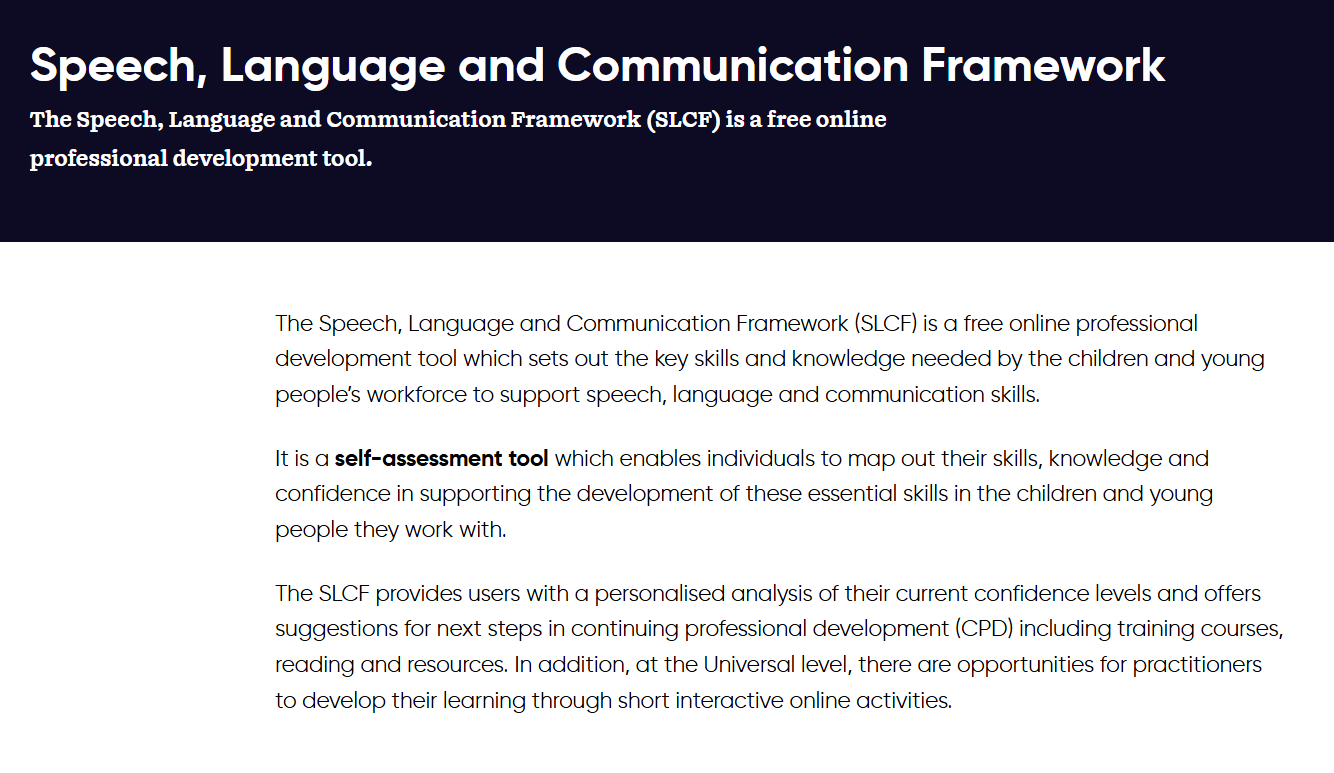
The skills discovery tool may recommend training, resources and organisations that can help you develop your knowledge and skills. Before investing your time or resources, consider whether a course, programme or approach is right for you and the children and young people you support.
When considering training or an approach, ask yourself:
- Is it based on current research and evidence?
- Are the claims realistic and proportionate?
- Are the trainers suitably qualified and experienced?
- Can the approach be adapted to different children, young people and contexts?
- Does it encourage professional judgement rather than promoting a single solution for every child, young person or situation?
Be cautious if training or an approach:
- promises quick, guaranteed or dramatic results
- claims to work for every child or young person
- relies mainly on testimonials, social media popularity, influencer endorsements or personal stories rather than evidence
- discourages questions, critical discussion or scrutiny
- lacks transparency about qualifications, costs, evidence or outcomes.
Use your professional judgement, review the evidence and always consider whether an approach is appropriate for the children and young people you support.
What Works database
If you want to explore the evidence behind speech, language and communication programmes, we recommend using our What works database.
It brings together information about a wide range of programmes and approaches and summarises the evidence available for each one.
Endorsed by the Royal College of Speech and Language Therapists, our What Works database can help you make evidence-informed decisions.
The database does not tell you which programme to choose. Instead, it helps you understand the available evidence so you can combine it with your professional judgement and knowledge of the child or young person.
Formal training is only one way to develop your knowledge, skills and confidence. You can also learn through:
- observing or shadowing colleagues, including speech and language therapists
- coaching, mentoring and peer support
- supervision, appraisal and professional discussions
- reflecting on your practice through activities such as:
- recording yourself (with appropriate consent)
- keeping a reflective journal
- seeking feedback from colleagues, children, young people and families
- professional networks and multi-agency working
- reading professional guidance, research and evidence-informed resources
- applying new learning in practice and reviewing its impact.
The most effective professional development often combines formal training with opportunities to practise, reflect, receive feedback and learn from others.