
Early Talk Boost Evaluation Project
-
Introduction
-
Project Resources
-
Programmes Tracker
-
Project Locations
-
Key contacts
Introduction
Welcome to Speech and Language UK Early Talk Boost Evaluation Page!
Here you will find some key resources for delivering the programme as well as some useful information to help you to meet some of the evaluation reporting requirements.
If you have any questions about the project, please contact project@speechandlanguage.org.uk.
If you have any questions about the project, please contact project@speechandlanguage.org.uk.
Project Resources
Training slides handout
Download the training slides handout.
Register
It is really important that the register is completed for each session using the unique child IDs provided by the study team (not children’s names). At the end of the intervention, we will ask you to share the register with us.
Download the register
Download the register
Parent Invitation to workshop
Download the parent invitation to the workshop
Parent Workshop
This workshop can be delivered to parent groups in three ways:
Download the presentation that can be delivered to parent groups in person or online
Download this recorded workshop along with the guidance notes on how to delivery it.
Download the presentation that can be delivered to parent groups in person or online
Download this recorded workshop along with the guidance notes on how to delivery it.
Early Talk Boost videos for Parents
If parents want to know about Early Talk Boost, they can watch these videos here.
Parent invitation to view photo book
Download the parent invitation
Early Talk Boost Photobook
Early Talk Boost Planning Board
Talking Tips
Download the Talking Tips
Tizzy Puppet
Download the Tizzy Puppet picture
Programmes Tracker
The Tracker is designed to help you select the children who’ll benefit most from Early Talk Boost and to measure their progress after they’ve taken part in the intervention. If you’ve observed a child who may be struggling with talking and understanding words, you can use the Tracker to support your observations.
The Tracker is not a whole-class screening tool. It is not a formal or standardised assessment and will not give age-related scores; nor does it replace other tracking and monitoring tools, although it may be used alongside them.
The tracker should be completed before you start Early Talk Boost with the children in the group and after you have finished.So that we can link your setting to this project, please log onto your tracker account, go to the Setting tab on the left hand side and tick the “Early Talk Boost EEF evaluation” project name.
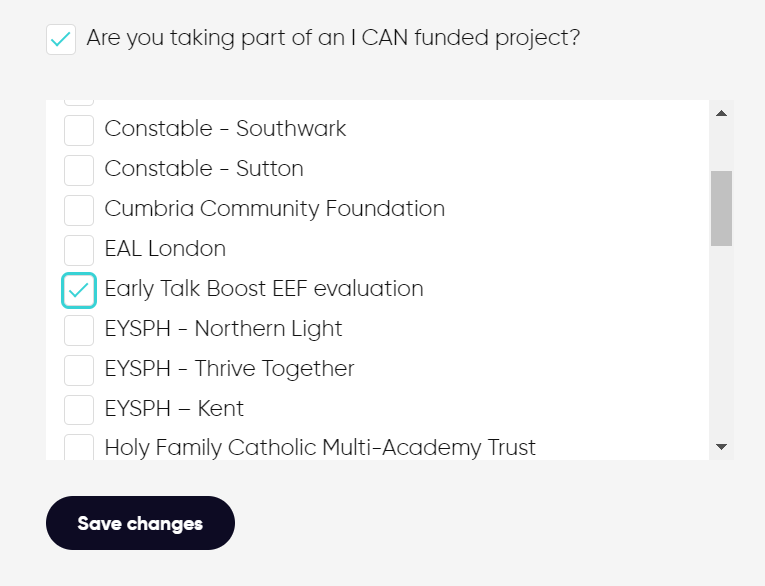
Setting up your online tracker account.
To use the online tracker, you must first create an account. Watch the quick start video which takes you through all the steps of using the online tracker.
You can also read the the following guides on how to use the tracker:
1. Read the "How to Guide"
2. Read our "Frequently asked questions".
If you have any difficulties using the online tracker, please send an email to info@speechandlanguage.org.uk
Project Locations
- East of England
- South West England
- West Midlands
Key contacts
Project support
project@speechandlanguage.org.uk
Speech and Language Support
Liz Wood 07912848697
Evaluation support
Jane Flynn - 07595414000
Deliveries and resources and tracker support
info@speechandlanguage.org.uk

Mailing List
Stay up-to-date with our latest news via email by signing up to our mailing list.
Contact Us
Speech and Language UK
Unit A The Cube Building
17-21 Wenlock Road
London
N1 7GT
Unit A The Cube Building
17-21 Wenlock Road
London
N1 7GT
General enquiries
020 7843 2510
info@speechandlanguage.org.uk
Media enquiries
media@speechandlanguage.org.uk
Empty space, drag to resize
Speech and Language UK is the operating name of I CAN Charity, a registered charity in England and Wales (210031) and Scotland (SC039947), which is a company limited by guarantee registered in England and Wales (00099629). Registered address: Unit A The Cube Building 17-21 Wenlock Road London N1 7GT
With thanks to our late patron the late Queen Elizabeth II
The skills discovery tool may recommend training, resources and organisations that can help you develop your knowledge and skills. Before investing your time or resources, consider whether a course, programme or approach is right for you and the children and young people you support.
When considering training or an approach, ask yourself:
- Is it based on current research and evidence?
- Are the claims realistic and proportionate?
- Are the trainers suitably qualified and experienced?
- Can the approach be adapted to different children, young people and contexts?
- Does it encourage professional judgement rather than promoting a single solution for every child, young person or situation?
Be cautious if training or an approach:
- promises quick, guaranteed or dramatic results
- claims to work for every child or young person
- relies mainly on testimonials, social media popularity, influencer endorsements or personal stories rather than evidence
- discourages questions, critical discussion or scrutiny
- lacks transparency about qualifications, costs, evidence or outcomes.
Use your professional judgement, review the evidence and always consider whether an approach is appropriate for the children and young people you support.
What Works database
If you want to explore the evidence behind speech, language and communication programmes, we recommend using our What works database.
It brings together information about a wide range of programmes and approaches and summarises the evidence available for each one.
Endorsed by the Royal College of Speech and Language Therapists, our What Works database can help you make evidence-informed decisions.
The database does not tell you which programme to choose. Instead, it helps you understand the available evidence so you can combine it with your professional judgement and knowledge of the child or young person.
Formal training is only one way to develop your knowledge, skills and confidence. You can also learn through:
- observing or shadowing colleagues, including speech and language therapists
- coaching, mentoring and peer support
- supervision, appraisal and professional discussions
- reflecting on your practice through activities such as:
- recording yourself (with appropriate consent)
- keeping a reflective journal
- seeking feedback from colleagues, children, young people and families
- professional networks and multi-agency working
- reading professional guidance, research and evidence-informed resources
- applying new learning in practice and reviewing its impact.
The most effective professional development often combines formal training with opportunities to practise, reflect, receive feedback and learn from others.